


News Center
Quality-oriented-value symbiosis
Breakthroughs in Sheet Metal Fabrication for NEV Lightweighting & Safety
Release time:
2025-03-19
As the global new energy vehicle market explodes (sales in 2023 will exceed 14 million, a year-on-year increase of 35%), sheet metal processing as a core process has ushered in new opportunities. From battery trays to body structures, sheet metal processing is indispensable in the manufacture of new energy vehicles. This article explores its key role and innovative applications.
With the explosive growth of the global new energy vehicle market, the sales volume of new energy vehicles will exceed 14 million in 2023, a year-on-year increase of 35%. Against this background, sheet metal processing, as one of the core processes of automobile manufacturing, is ushering in unprecedented development opportunities. From battery trays to body structures, sheet metal processing plays an indispensable role in the manufacturing of new energy vehicles. This article will explore in depth the key role and innovative applications of sheet metal processing in the field of new energy vehicles.
The key role of sheet metal processing in the manufacturing of new energy vehicles
1. Key support for lightweight design
New energy vehicles have an urgent need for light weighting, because every 10% reduction in body weight can increase the range by 5%-8%. Sheet metal processing uses high-precision cutting, bending and welding to process lightweight materials such as aluminum alloys and high-strength steel into complex body parts, which not only ensures strength but also achieves weight reduction goals.
2. Core manufacturing process of battery tray
The battery tray is the "heart" of new energy vehicles, and its precision and strength are directly related to the safety of the battery and the performance of the whole vehicle. Sheet metal processing ensures the dimensional accuracy and sealing of the battery tray through laser cutting, CNC bending and automated welding, while meeting the stringent requirements of fire prevention and shock resistance.
3. High-strength guarantee of the body structure
The body structure of new energy vehicles needs to withstand higher collision safety standards. Sheet metal processing uses precision stamping and welding processes to process high-strength steel into key components such as A-pillars and B-pillars, significantly improving the impact resistance of the body.
Innovative application of sheet metal processing in the field of new energy vehicles
1. Breakthrough in laser cutting technology
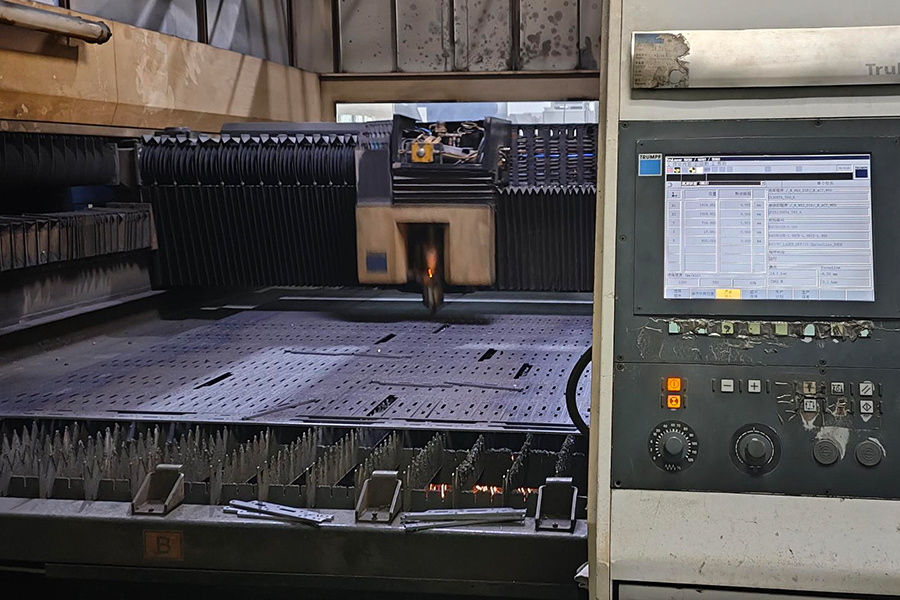
Laser cutting technology has become the first choice for sheet metal processing of new energy vehicles, with its high precision and high efficiency. For example, the fiber laser cutting machine can achieve a cutting accuracy of ±0.05mm on a 0.5mm thick stainless steel plate, meeting the stringent requirements of battery trays and body structural parts. Some companies combine laser cutting with AI vision technology to realize automatic recognition and cutting of complex shapes, further improving processing efficiency.
2. Popularization of automated welding robots
Welding is a key link in sheet metal processing of new energy vehicles, especially the sealing welding of battery trays. Automated welding robots can stably complete difficult welds through preset programs to ensure the consistency of welding quality. Some companies have introduced collaborative robots (Cabot) to achieve human-machine collaborative welding, which not only improves efficiency but also reduces labor costs.
3. Application of flexible production lines
The demand for customization of new energy vehicles is growing, and flexible production lines have become an important trend in sheet metal processing. Through CNC technology and rapid mold change systems, a production line can simultaneously process sheet metal parts of multiple models to meet the production needs of small batches and multiple varieties.
4. Exploration of green sheet metal processing
The new energy vehicle industry has extremely high requirements for environmental protection, and green sheet metal processing has become a new direction. For example, water cutting technology is used to replace traditional oily coolants to reduce environmental pollution; recyclable materials are used to process sheet metal parts to reduce carbon emissions.

Future trends: intelligent and digital drive
1. Intelligent upgrade
By introducing AI algorithms and Internet of Things technologies, sheet metal processing equipment can achieve self-diagnosis, automatic parameter adjustment and remote monitoring, further improving production efficiency and product quality.
2. Digital management
Using MES (Manufacturing Execution System) and ERP (Enterprise Resource Planning) systems, enterprises can achieve digital management of the entire process from order receipt to finished product delivery, optimize resource allocation, and reduce operating costs.
3. New materials and new processes
With the application of new materials such as magnesium alloys and carbon fibers, sheet metal processing technology will continue to innovate, providing more possibilities for the lightweight design of new energy vehicles.
From battery trays to body structures, sheet metal processing plays an irreplaceable role in the manufacturing of new energy vehicles. With the continuous innovation of technology, sheet metal processing is transforming from traditional manufacturing to intelligent and green, providing strong support for the high-quality development of the new energy vehicle industry. In the future, sheet metal processing companies can only remain invincible in the fierce market competition by keeping up with industry trends and continuing to innovate.
Key Words
Related Information
Quality-oriented-value symbiosis

Address: No.8, Chuangye East Road, Xiaolin District, Liangang Industrial Zone, Jinwan District, Zhuhai City, Guangdong Province
Links: