


News Center
Quality-oriented-value symbiosis
Sheet Metal Welding: Precision Joining & Applications
Release time:
2025-04-30
Welding technology plays a key role in the sheet metal processing system. Through arc welding, resistance welding and laser welding, the connection between components is strengthened, and the mechanical properties, sealing and service life of the product are improved.
In the sheet metal processing system, welding technology plays a key role as a "metal bond" - through heating or pressurizing, separated sheet metal parts can be combined atomically to form a complete structure. Compared with bending shaping and stamping forming, welding focuses on strengthening the connection between parts, and its technical precision directly affects the mechanical properties, sealing and service life of the product. In the manufacturing of products such as inkjet printer chassis, stage lighting accessories, and liquid medicine agitators, welding processes need to formulate differentiated technical solutions based on different material properties and functional requirements.
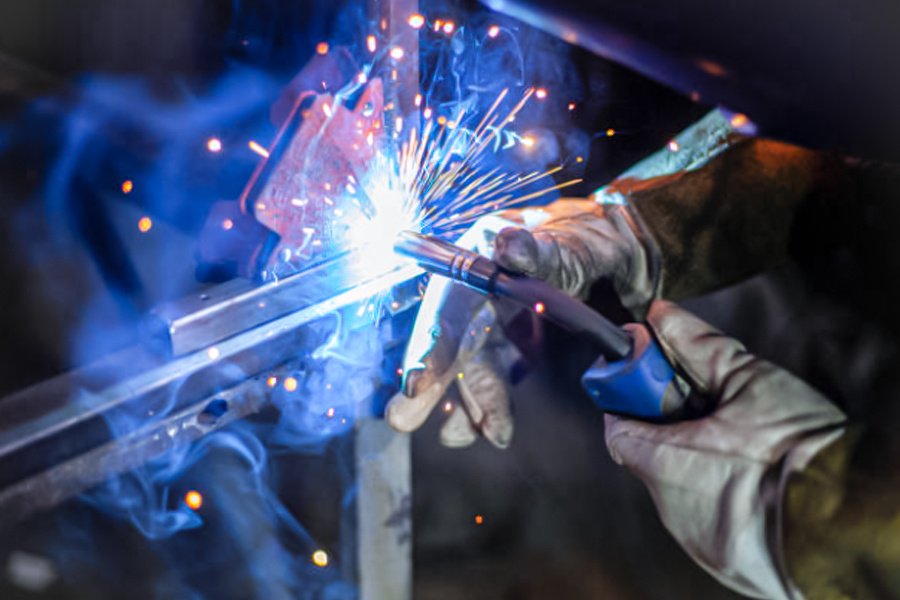
Core classification and technical characteristics of welding processes
1. Arc welding: the most versatile fusion welding technology
Arc welding melts the base material and welding wire through the high temperature generated by arc discharge to form a weld. Among them, carbon dioxide gas shielded welding (CO₂ welding) is widely used in carbon steel and low alloy steel welding due to its low cost and high deposition rate. For example, when welding the stainless steel tank body and flange of the liquid agitator, pulse MIG welding (molten inert gas shielded welding) is used. By controlling the pulse current frequency (recommended 50-100Hz) and argon gas flow (15-20L/min), the heat input can be reduced, intergranular corrosion of stainless steel can be avoided, and the weld formation can be beautiful.
2. Resistance welding: an efficient thin plate connection solution
Resistance welding uses the resistance heat generated by the current passing through the contact point of the weld to melt the metal, including spot welding, seam welding, projection welding and other forms. In the connection of thin plate components of the inkjet printer chassis, the spot welding process performs outstandingly: the cold-rolled steel plate with a thickness of 0.8-2mm is welded by customizing the electrode (diameter 3-5mm, end face taper 120°), and the single-point welding time is controlled at 0.08-0.12 seconds, which can not only form a firm weld with a diameter of 4-6mm, but also avoid the deformation of the chassis shell due to overheating, and ensure the surface flatness of the subsequent spraying process.
3. Laser welding: the first choice for precision and automation
Laser welding achieves local rapid melting with high energy density beams, and has the advantages of narrow welds (0.2-0.5mm) and small heat-affected zones, making it particularly suitable for welding lightweight materials such as aluminum alloys. In the welding of aluminum alloy lamp stands for stage lighting accessories, fiber laser welding technology is used, with the focus spot diameter controlled at 0.1mm and the welding speed reaching 5-8m/min. It can not only complete the connection of complex curved surfaces (such as vertical welding of arc brackets and connecting plates), but also monitor the weld offset in real time through the machine vision system, and control the positioning error within ±0.1mm.
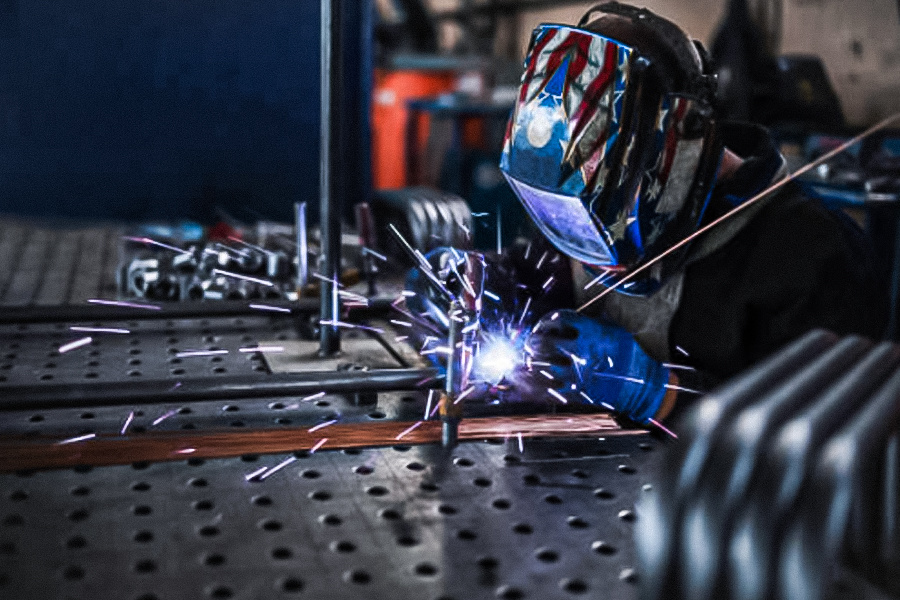
Scenario-based application of welding technology in segmented products
1. Inkjet printer chassis: dual guarantee of sealing and electromagnetic shielding
As an electronic device, the chassis welding of inkjet printers must meet two core requirements:
● Sealing welding: The joints between the side panels and the bottom panel of the chassis are welded by continuous seam welding, and the weld height is not less than 80% of the thickness of the plate. The airtightness is tested by a helium mass spectrometer leak detector (leakage rate ≤1×10⁻⁹mbar・L/s) to prevent dust and moisture from invading and affecting the performance of the circuit board.
● Electromagnetic shielding reinforcement: In the welding of the shielding cover inside the chassis, the copper foil shielding strip is fixed to the sheet metal frame by a projection welding process, and the spacing between the solder joints is controlled at 20-30mm to form a continuous conductive path. After testing, the electromagnetic radiation leakage value can be reduced by more than 60% (in compliance with EN 55032 Class B standard).
2. Stage lighting accessories: welding challenges and countermeasures for lightweight materials
The difficulty of welding aluminum alloy accessories (such as lamp body brackets and heat sink fins) lies in the removal of oxide film and control of thermal deformation:
● Pretreatment process: Before welding, mechanical grinding (80# sandpaper) combined with chemical cleaning (immersion in 5% NaOH solution for 3 minutes) is used to completely remove the Al₂O₃ oxide film on the surface to avoid pore defects in the weld.
● Deformation control: For the welding of thin-walled fins (thickness 1.5mm), the "tooling fixture + segmented jump welding" technology is used - the workpiece is fixed on a three-dimensional adjustable fixture, and the welding is performed in segments at intervals of 10mm. The welding time for each segment is 0.3 seconds. After cooling, the next segment is carried out, so that the flatness error of the fin is reduced from 0.8mm in traditional welding to 0.3mm.
3. Liquid agitator: balanced design of corrosion resistance and structural strength
The welding of the agitator needs to take into account the corrosion resistance of 316L stainless steel and the dynamic load requirements of the agitator components:
● Weld design: The connection between the agitator shaft and the paddle is fully penetrated, and the root of the weld is 100% radiographically inspected (RT inspection) to ensure that there are no unfused defects; the weld surface is electrolytically polished (roughness Ra≤0.4μm) to eliminate the risk of residual liquid.
● Stress relief: After welding, the agitator body is annealed as a whole (heated to 550℃ for 2 hours). Metallographic analysis shows that the residual stress in the weld area is 40% lower than that of the untreated parts, effectively avoiding fatigue cracking caused by long-term stirring vibration.
Technical evolution and industrial value of welding technology
Sheet metal welding technology is transforming from "extensive connection" to "precision manufacturing". Through deep integration with robot welding systems and laser vision tracking technology, it has achieved a leap from manual operation to intelligent production. In the sealing welding of inkjet printer chassis, lightweight welding of stage lighting accessories, and corrosion-resistant welding of liquid agitators, welding technology is not only a means of connecting components, but also a key link to improve product reliability. In the future, with the application of new materials (such as magnesium alloys and composite materials), welding technology will continue to innovate in process adaptability, degree of automation, quality traceability system, etc., providing more solid technical support for high-end equipment manufacturing.
FAQ
Q1: Can sheet metal parts of different materials be directly welded?
A1: Material compatibility needs to be considered. For example, stainless steel and aluminum alloy welding requires a transition layer (such as copper foil) and special welding wire (such as ER309L), while controlling the welding heat input to reduce the generation of brittle phases.
Q2: How to judge whether the corrosion resistance of the weld meets the standard?
A2: A salt spray test (5% NaCl solution, 35℃ constant temperature spray for 48 hours) can be carried out to observe whether rust appears on the weld surface; or the intergranular corrosion test (GB/T 4334 standard) can be used to detect the corrosion tendency in the sensitization temperature range.
Q3: How to avoid burn-through when welding thin plates?
A3: Use low-power welding equipment (such as micro-beam plasma welding), with high-frequency pulse current (frequency 100-200Hz), and set a copper pad (thickness 3-5mm) on the back of the weldment to quickly dissipate heat through heat conduction to control the size of the molten pool.
Key Words
Related Information
Quality-oriented-value symbiosis

Address: No.8, Chuangye East Road, Xiaolin District, Liangang Industrial Zone, Jinwan District, Zhuhai City, Guangdong Province
Links: